
Circular Material Infrastructure for Earth and Space
Re:Weave™ is a system for turning waste into resources, continuously.
It transforms textile waste, biological residues, and mineral inputs into new materials through a closed-loop infrastructure that integrates textiles, biology, robotics, and data.
Designed for both industrial systems and space environments, Re:Weave enables low-energy, chemical-free material recovery, where nothing is lost, only transformed.
Today’s material systems are still linear:
Extract →
Produce →
Use →
Discard
Less than 1% of textiles are recycled into new materials, while industries face growing requirements for circularity, traceability, and accountability (Niinimäki et al., 2020; Ellen MacArthur Foundation, 2017).
At the same time, regulation is shifting rapidly:
Products must be designed for recovery (ESPR)
Materials must be traceable (DPP)
Producers must manage end-of-life (EPR)
Companies must report full lifecycle impact (CSRD)
Circularity is no longer optional, it is becoming infrastructure.
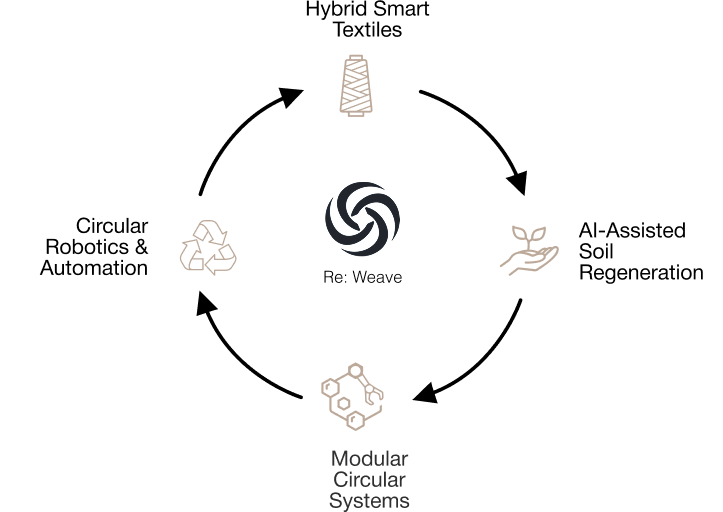
Re:Weave creates a structured closed-loop system in which materials are continuously recovered, regenerated, and reintegrated. Waste becomes resource and resources become new materials. The platform is built on four integrated pillars.
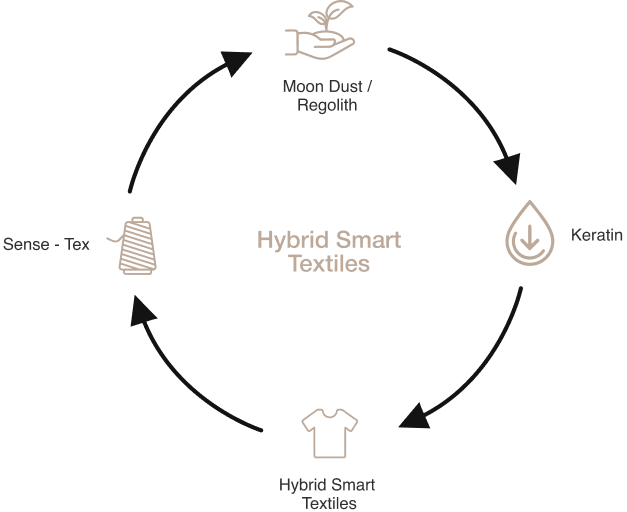
Hybrid Smart Textiles
Advanced textile materials engineered from Sense-Tex, Regolith/Basalt fibres, combined with Keratin binders.

Environmental Regulation

Closed-Loop Production

System Integration

Eco-Friendly Safety
AI-Assisted Soil Regeneration
Biological and microbial processes convert organic residues from textile and production systems into fertile soil substrates.
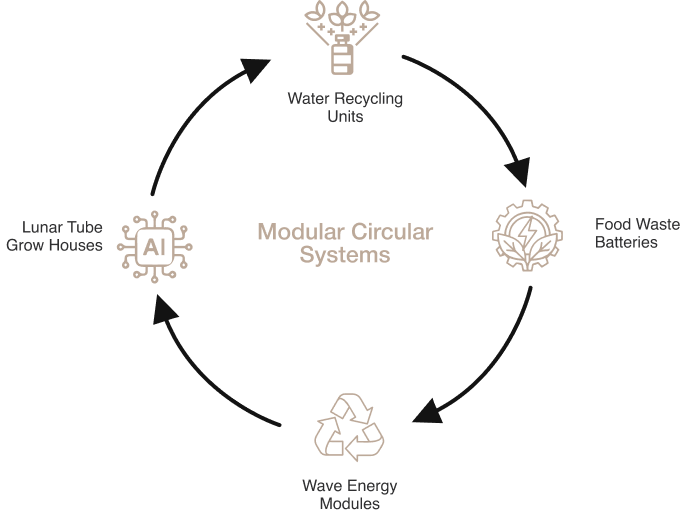
Modular Circular Systems
Infrastructure for exchanging water, nutrients, and material flows.
Eco-Friendly Sorting

Sterile Operations

Non-Stop Automation

Circular Integration
Circular Robotics & Automation
Soft robotic systems for continuous material recovery.
Re:Weave is designed to operate across multiple industries and environments, adapting to different material flows and system requirements.
Fashion and Textile Industries
In fashion and textile industries, it enables post-consumer recovery and circular product systems, supporting brands in meeting regulatory and sustainability targets. In manufacturing, it allows recovery of production waste and reintegration of materials into new cycles, reducing dependency on virgin resources.
Space Environments
In space and advanced environments, Re:Weave provides the foundation for closed-loop systems where materials, energy, and biological processes must operate together without external supply chains. This makes it relevant not only for Earth-based industries, but also for future off-world systems.
Healthcare and Defense Technology
In healthcare and defense, it supports controlled material flows, traceability, and secure handling of textiles where performance and compliance are critical.
Smart Industries
In urban and industrial environments, it enables distributed circular infrastructure that can process materials closer to where they are used.
1. Start with Your System
Existing Materials, Products or waste Streams
2. Choose Your Entry Point
Select a point of entry or combine for a full system
3. Continuous Circular Flow
Recovery → Transformation → Reintegration

Start with Your System
Existing Materials, Products or waste Streams


Choose Your Entry Point
Select a point of entry or combine for a full system

System Integration
Connect Materials, Recovery and Processing

Continuous Circular Flow
Recovery → Transformation → Reintegration

Re:Weave is designed to be implemented in different ways depending on the level of integration required.
It can be deployed as a full circular system, where all four pillars operate together to create a closed-loop infrastructure for materials, energy, and biological processes. This approach is relevant for new facilities, advanced environments, and long-term system design where circularity is built in from the beginning. At the same time, each pillar can be used independently.
Hybrid material systems such as Sense-Tex can be licensed and integrated into existing product lines, enabling circular-ready materials without requiring immediate infrastructure change. AI soil transformation units can be deployed to support regenerative systems and biomass production in controlled environments. Modular processing systems, including bioreactors and recovery units, can be integrated into existing factories to improve material recovery and reduce waste. Circular robotics and AI control systems can be introduced to automate sorting, processing, and system optimization.
This modular approach allows companies to transition gradually, starting with specific material streams or system components and expanding over time. Re:Weave therefore functions both as a complete infrastructure system and as a set of interoperable technologies that can be adopted step by step.
Re:Weave replaces linear systems with a continuous loop:
Recover → Regenerate → Reintegrate
• Materials are designed to be taken apart
• Materials are recovered without chemicals
• Materials are rebuilt into high-value materials
• Materials are tracked across their full lifecycle
Waste becomes a resource. Resources become material again.
Re:Weave operates as a modular system across industries and environments.This creates a continuous circular flow, adaptable to factories, cities, healthcare systems, and space habitats.
Textile waste, production offcuts, organic residues, or mineral resources
Mechanical separation, biological regeneration, and system-level routing
Materials restored into fibers, substrates, or energy flows
Recovered materials returned into production systems
Re:Weave is built on four integrated layers:
Hybrid Materials
Textiles engineered for durability, traceability, and recovery→ Designed for disassembly and fiber-to-fiber reuse
Ai Soil Regeneration
Organic waste converted into soil and nutrient systems → Closing the loop between material and biological cycles
Modular Infrastructure
Systems for water, energy, and material flow → Scalable across industries and environments
Circular Robotics and Automation
Robotic systems for sorting and recycling → Continuous, chemical-free material recovery
Most recycling systems fail because they operate after the problem.
Re:Weave works because it is designed before the problem:
Materials are created for recovery
Systems are built for circulation
Data enables full lifecycle visibility
This aligns directly with emerging regulatory frameworks and enables system-level compliance.
Re:Weave shifts cost from waste to value. Compared to conventional systems:
Higher material recovery → increased resource efficiency
Lower energy use → reduced operational cost
Reduced waste → lower disposal and compliance cost
Proactive compliance → reduced regulatory risk
Lower lifecycle cost → improved total cost of ownership
Instead of optimizing for lowest upfront cost, Re:Weave optimizes for long-term system performance.
Manufacturing & Fashion
Healthcare Systems
Defense & Disaster Response
Urban Infrastructure
Space Missions and Habitats
Re:Weave reframes textiles from products into infrastructure.
From: → Disposable Materials To: → Regenerative Systems
Re:Weave is not a single solution it is a framework for building circular systems across industries and environments. It provides a pathway from linear production to circular infrastructure, allowing companies to transition at their own pace while maintaining performance, compliance, and economic viability. Explore Sense-Tex or contact TTAB to begin integration.
Hybrid Textile System (Sense-Tex × Regolith × Keratin)
Multifunctional textile system combining sensing fibers, minerals, and biological binders.
Sense-Tex Hybrid Fiber Production Process
Embeds sensing and functional materials into fibers
Keratin Binder Integration System (KBIS)
Natural protein-based composite binding
Hydrogel Water-Bead Integration System (HWBIS)
Moisture storage and release in fibers
Regolith–Basalt Fiber Composite Yarn (RBFCY)
High-strength yarn from planetary materials
Graphene-Free Conductive Network (GFCN)
Alternative conductive textile system
Fiber–Battery Weaving Integration System (FBWI)
Energy storage integrated into textiles
Aloe Vera Bead Microcapsule System (AVBMS)
Bioactive textile system for skin interaction
Antimicrobial + Radiation Shield Layer (ARSL)
Protective layer for extreme environments
AI Soil Transformation Platform (ASTP)
Soil AI Node Microcontrollers (S-AINs)
Distributed AI soil monitoring
Perchlorate-Reduction Microbial Reactor (PRMR)
Biological detoxification system
Modular Circular Systems
Zero-waste system architecture
Bio-Sensing Energy Piping System (BSEPS)
Tracks flow, energy, and biological activity
Water Recycling System (WRS)
Closed-loop water reuse
Wave Energy Module (WEM)
Motion-based energy generation
Circular Robotics Cluster (ARC)
Coordinated recycling and manufacturing robots
Microgravity Recycling Unit (MRU)
Recycling in low-gravity environments
Modular Robotic Textile Recycling Framework (MTRF)
Natural protein-based composite binding
Circular Robotics Factory (CRF)
Fully automated circular production
Intelligent Manipulation Arm (IMA)
Precision AI robotic handling
AI-Assisted Fiber Extrusion Feedback System (AFEFS)
Real-time fiber production optimization
Textile-Embedded AI Bus (TEAB)
Data communication within textiles
Adaptive AI Energy Management Grid (AAI–EMG)
AI energy optimization system
Sustainability Performance Index (SPI)
Real-time environmental monitoring dashboard
Lunar Tube Growhouses (LTG)
Protected lunar agriculture systems
Adaptive Truss ExoFrame (ATX)
Load-adaptive structural framework
Soft Robotic Stabilization System (SRSS)
Dynamic stabilization systems
Vibration Isolation & Thermal Control (VIS + TCS)
Environmental control systems
Autonomous Habitat Assembly Framework (RDF)
Self-building robotic habitats